EN
EN

News
Top & Bottom Synchronous Labeling Machine – Optimize Your Packaging Line
Time : 2026-09-24
Hits : 0
In modern automated packaging production, efficiency and labeling accuracy are the core factors that determine the overall productivity of the production line. Traditional single-sided labeling equipment requires secondary flipping and repeated labeling procedures for products that need double-sided marking, which not only reduces production efficiency but also easily causes labeling deviation, wrinkling and other quality problems. To solve this industry pain point, the top and bottom synchronous labeling machine has become an essential intelligent device for mainstream packaging factories, helping enterprises achieve fast, stable and high-standard double-sided labeling operations.
How Does the Top and Bottom Synchronous Labeling Machine Work?
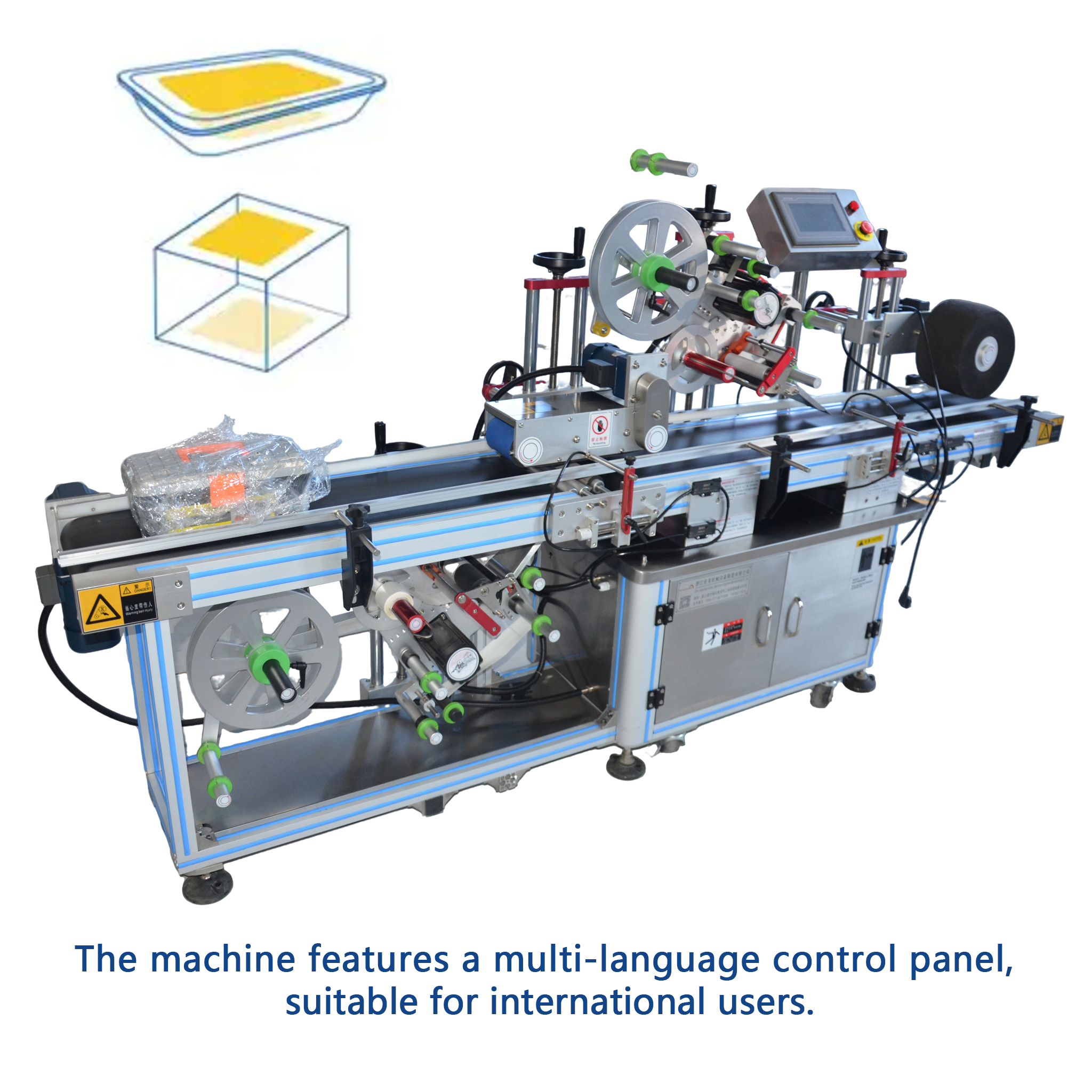
Different from ordinary labeling equipment, this synchronous labeling machine is equipped with two independent high-precision labeling heads on the upper and lower sides. During operation, products are stably transported through the conveyor belt to the labeling station. The photoelectric sensor automatically identifies the product position and triggers the upper and lower labeling heads to discharge labels synchronously.
The entire labeling process is completed in one pass: the top labeling head accurately attaches the label to the product surface, while the bottom labeling head synchronously finishes the bottom labeling. There is no need for manual flipping or secondary positioning, realizing one-time forming of double-sided labeling and greatly simplifying the production process.
Core Advantages of Synchronous Double-Sided Labeling
1. Dramatically Improve Production Efficiency
The one-time synchronous labeling mode completely eliminates the redundant process of secondary labeling. It realizes continuous and uninterrupted assembly line operation, effectively increases the daily output of the production line, and solves the bottleneck of low efficiency of traditional double-sided labeling.
2. Stable and Uniform Labeling Quality
Adopting synchronous servo control technology, the upper and lower labeling heads run in precise coordination, with consistent labeling position and high repetition accuracy. It effectively avoids common problems such as label deviation, warping, bubbles and falling off caused by manual operation and secondary positioning, ensuring neat and uniform product labeling appearance.
3. Wide Compatibility with Products and Labels
The equipment has strong adaptability and is suitable for most flat, box-type, tray and bag products, including food packaging boxes, aluminum foil bags, daily chemical flat bottles, medical cartons, electronic accessories and industrial parts. Meanwhile, it supports various label materials, such as common self-adhesive labels, PET transparent labels, tear-resistant synthetic paper labels, and freezer-resistant thermal labels, perfectly meeting the labeling needs of cold chain, normal temperature and special production environments.
4. Easy Integration and Low Maintenance Cost
This automatic labeling machine can be seamlessly connected with upstream and downstream equipment such as filling machines, sealing machines and TTO coding machines to realize integrated production of labeling, date printing and traceability coding. In addition, the mechanical structure is optimized and simplified, with stable operation, low failure rate and convenient daily maintenance, which greatly reduces enterprise labor and after-sales costs.
Main Application Scenarios
Widely used in food and cold chain, daily chemical packaging, pharmaceutical industry, electronic manufacturing, hardware accessories and other fields. It is especially suitable for mass production scenarios where products need top and bottom double-sided identification, providing standardized and intelligent labeling solutions for industrial automated production lines.
Final Words
As an upgraded intelligent labeling device, the top and bottom synchronous labeling machine perfectly solves the efficiency and quality problems of traditional double-sided labeling. It helps enterprises reduce production costs, improve product packaging grade and market competitiveness, and is the preferred equipment for modern packaging line upgrading and transformation.