EN
EN

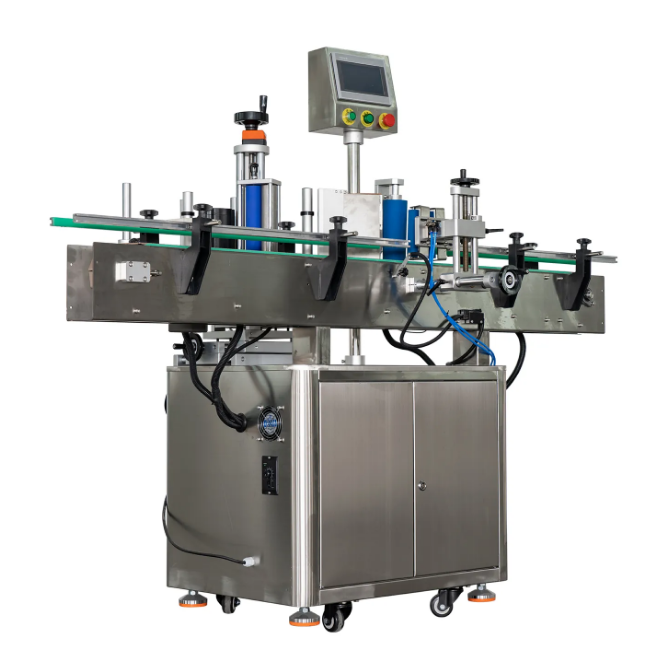
Roll-On Labeling Works Differently From Wipe-On
Labeling machines get grouped together in conversation, but the mechanism that transfers the label onto the container makes a bigger difference than most people think. A roll-on applicator picks up the label from the backing web using a rubber or silicone roller and transfers it directly onto the product surface by matching the surface speed of the container. This contact-transfer approach produces consistent pressure across the entire label face, which is why it handles curved surfaces, textured containers, and recessed panels better than blow-on or wipe-on methods.
For food packaging, where containers range from smooth PET jars to ribbed glass bottles to squeeze tubes with irregular profiles, the roll-on method keeps the label flat and fully adhered without wrinkles. That visual quality matters at retail, where consumers associate label condition with product freshness and brand professionalism.
The Label Dispenser Module: Where Accuracy Starts
The dispenser module peels the label from its liner and presents it at a precise position for pickup by the applicator roller. Two sub-assemblies handle this: the unwind mechanism that feeds the label stock, and the peeling edge, usually a hardened steel bar, that bends the web sharply enough for the label to separate from its backing.
On a well-engineered automatic roll-on labeling machine, the peeling edge is adjustable in fractions of a millimeter. This matters because label constructions vary. A paper label with a standard acrylic adhesive peels cleanly at a sharper angle, while a clear film label with a low-tack adhesive may need a gentler peel radius to avoid stretching or curling before transfer. If the peel angle is wrong for the label stock, the result is either incomplete transfer or a label that arrives pre-distorted, which then shows up as bubbles or edge lift on the container.
The Applicator Roller and Why Its Material Composition Matters
The roller that presses the label onto the container is arguably the most underappreciated component in the entire system. It needs to accomplish three things simultaneously: match the container surface speed with zero slippage, apply uniform pressure across the full label width, and do both of those without damaging the label face or leaving marks on the container.
Roller materials are chosen based on the application. Standard nitrile rubber handles most general-purpose food containers. Silicone rollers work better when the label adhesive is aggressive and might stick to the roller surface. Polyurethane rollers offer higher durability on high-speed lines where the roller cycles thousands of times per shift.
| Roller Material | Hardness Range (Shore A) | Typical Cycle Life Before Resurfacing | Best Application Match |
|---|---|---|---|
| Nitrile rubber | 50 to 70 | 2-4 million cycles | General food containers, metal cans |
| Silicone | 40 to 60 | 1-2 million cycles | Low-tack adhesives, film labels |
| Polyurethane | 65 to 85 | 5-8 million cycles | High-speed lines, abrasive container surfaces |
During a 2022 retrofit project at a condiment manufacturer in Jiangsu, the production team discovered that frequent label edge lift on their glass jar line was traced not to adhesive failure, but to roller wear that had created a subtle crown profile on the nitrile roller. After switching to a polyurethane roller and recalibrating the pressure, edge lift incidents dropped from roughly 8 per 1,000 jars to fewer than 1 per 5,000.
Conveyor Synchronization and Product Handling
The label has to meet the container at exactly the right moment and with matched surface speed. This requires the conveyor to feed containers at a consistent pitch, typically maintained by a timing screw or a lane divider that spaces products evenly before they enter the labeling zone.
Speed synchronization between the applicator roller and the conveyor is handled by an encoder on the conveyor drive shaft. The encoder sends real-time position data to the labeling controller, which adjusts the roller speed to match. On lines that handle variable container sizes within the same SKU family, this synchronization logic has to be fast enough to compensate for diameter changes without accumulating registration error over a production run.
The Control System: Brains Behind the Mechanical Motion
Modern roll-on labeling machines run on servo-based motion controllers rather than the older pneumatic or cam-driven systems. Servo control allows independent adjustment of dispense speed, roller speed, and conveyor speed, which means the same machine can handle a wide range of container sizes and label formats by changing parameters in the HMI rather than physically adjusting mechanical linkages.
Recipe management is a practical feature that directly impacts changeover time. When a line switches from a 250 ml jar to a 500 ml bottle, the operator loads a saved recipe that sets the label dimensions, dispense offset, roller pressure, and conveyor spacing. Done right, the changeover takes minutes instead of the 30 to 45 minutes that older mechanically adjusted machines require.
Why the Right Manufacturing Partner Changes the Equation
A roll-on labeling machine is only as reliable as the engineering behind its components. Henan Best Packing Machine has spent 15 years building labeling and packaging equipment in an ISO 9001-certified facility, with 20 invention patents backing their designs. Their roll-on labeling systems combine precision dispenser modules, application-specific roller options, and servo-driven synchronization into a package that handles the diversity of food container shapes and materials that modern production lines demand. For operations running multiple container formats across multiple shifts, that kind of component-level engineering depth makes a measurable difference in both label quality and line uptime.
Table of Contents
- Roll-On Labeling Works Differently From Wipe-On
- The Label Dispenser Module: Where Accuracy Starts
- The Applicator Roller and Why Its Material Composition Matters
- Conveyor Synchronization and Product Handling
- The Control System: Brains Behind the Mechanical Motion
- Why the Right Manufacturing Partner Changes the Equation