EN
EN

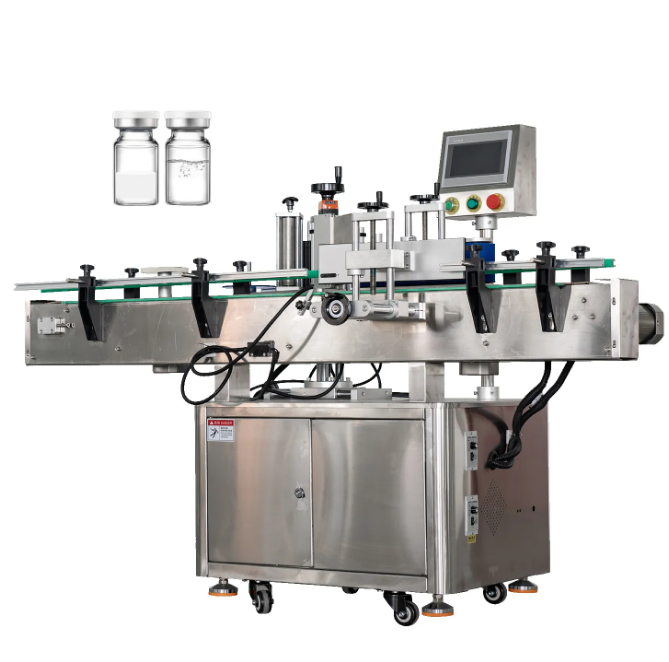
Top and Bottom Labeling Demands More Than Two Machines Side by Side
Containers that carry labels on both the top panel and the bottom panel are common across beverage, food, personal care, and household product lines. Running two separate label stations in sequence is possible, but it introduces a coordination problem: the top label and the bottom label must align to the same container datum, and any positional drift between the two stations accumulates as a registration error that gets worse throughout a production run. An automatic two-side label applicator solves this by applying both labels in a single pass through a unified mechanical framework, ensuring that the top and bottom images share a consistent spatial relationship from the first container to the ten-thousandth.
The synchronization challenge is mechanical, not just electronic. Both labeling heads need to fire within a narrow time window relative to the container position, and the container itself needs to be stabilized between the two application points so that neither label is applied to a moving, shifting surface.
The Conveyor Split: How Containers Enter the Dual-Label Zone
Most two-side labeling systems use a split-conveyor configuration. The product travels on a center transport belt and passes between two opposing applicator heads mounted above and below. Some designs use a top belt and a bottom belt that grip the container from both sides to stabilize it during labeling. Others rely on guide rails that hold the container laterally while it rides on a single belt, with the top label applied from above and the bottom label from a turret beneath the conveyor.
The choice between gripped transport and rail-guided transport depends largely on container stability. Tall, narrow bottles tend to wobble, which kills label placement accuracy. A top-and-bottom belt grip solves this but adds mechanical complexity and makes changeover between different container diameters slower. Rail-guided systems are simpler and faster to change over, but they work best on containers with a low center of gravity.
Sensor Architecture and the Timing Window
Synchronization between the top and bottom labeling heads relies on a master sensor, usually a photoelectric or ultrasonic device, that detects the leading edge of the container entering the label zone. That detection event triggers a delay timer calibrated to the distance between the sensor and each applicator head. The top head fires at delay value A, the bottom head fires at delay value B, and both values are tuned so the labels land on the correct positions simultaneously.
| Synchronization Method | Timing Accuracy | Changeover Complexity | Common Application |
|---|---|---|---|
| Fixed mechanical delay | +/- 1.5 to 2.0 mm | Low | Stable container sizes, long runs |
| Encoder-based master timing | +/- 0.5 to 0.8 mm | Medium | Variable sizes within a family |
| Servo-linked dual-head | +/- 0.2 to 0.4 mm | Higher setup, lower runtime adjustment | Multi-format, high-value containers |
During a 2023 capacity expansion at a beverage co-packer in Guangdong, the engineering team evaluated a fixed-delay system against a servo-linked two-side label applicator for their 600-bottle-per-minute juice line. The fixed-delay unit was cheaper upfront but required recalibration every time the conveyor speed varied by more than 3%. The servo-linked system maintained consistent registration across a 15% speed range without manual intervention, and rejected-label rates from misalignment dropped from 2.1% to under 0.3% over the first quarter of operation.
Pressure Balance Between Top and Bottom Application
Applying labels from opposite sides simultaneously creates opposing forces on the container. If the pressure from the top applicator is significantly different from the bottom applicator, the container can shift laterally during the labeling moment, which causes both labels to land off-center. Calibrated pneumatic cylinders or servo-driven tamp units on both sides, linked to a common pressure reference, keep the opposing forces balanced.
The balance does not need to be identical, but it needs to be consistent. On containers with an asymmetrical profile, for example a bottle with a domed top and a flat bottom, the contact area differs between the two sides. The system compensates by adjusting tamp dwell time and roller pressure independently for each head rather than trying to match a single global setting.
Handling Variable Container Heights and Diameters
Production lines that run multiple SKU families on the same equipment face a specific engineering challenge with two-side labeling. The distance between the top applicator and the bottom applicator must adjust to accommodate different container heights, and the centering mechanism must track diameter changes to keep both labels positioned correctly.
Modern designs handle this through motorized height adjustment on the top applicator column and interchangeable guide rail sets for diameter changes. The best systems store these mechanical positions within the same recipe structure that holds the label parameters, so a single recipe call-up adjusts both the labeling data and the physical machine geometry at the same time.
Selecting the Right Partner for Dual-Side Labeling Complexity
Two-side labeling adds a layer of mechanical coordination that single-side systems never have to address. The engineering has to manage synchronized timing, balanced pressure, container stabilization, and multi-format changeover within a single machine frame. Henan Best Packing Machine, with 15 years of ISO 9001-certified manufacturing experience and a portfolio covering labeling, filling, capping, and coding equipment, designs two-side label applicators that integrate servo-linked synchronization with modular mechanical architectures. For operations running dual-labeled products across shifting production schedules, that integrated engineering approach translates into fewer alignment issues and less time lost to changeover adjustments.
Table of Contents
- Top and Bottom Labeling Demands More Than Two Machines Side by Side
- The Conveyor Split: How Containers Enter the Dual-Label Zone
- Sensor Architecture and the Timing Window
- Pressure Balance Between Top and Bottom Application
- Handling Variable Container Heights and Diameters
- Selecting the Right Partner for Dual-Side Labeling Complexity