EN
EN

Pharmaceutical Labeling Is Not Like Putting Stickers on Boxes
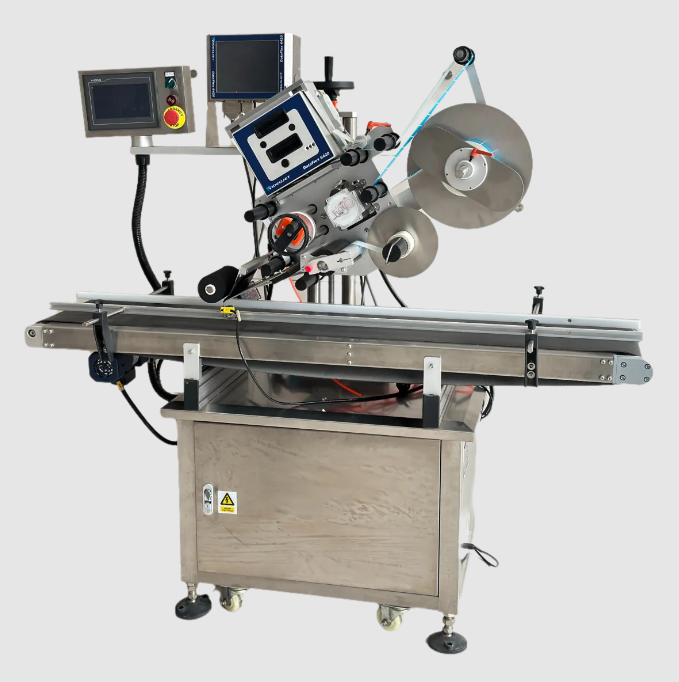
Applying a label to a medicine bottle sounds simple enough until the regulatory requirements enter the picture. Drug products in most regulated markets carry mandatory data: batch numbers, expiry dates, serial codes for track-and-trace, dosage instructions, and sometimes tamper-evident features layered into a single label construction. The label has to land straight, bubble-free, and positioned within tight tolerances, often on a container moving at 150 to 300 units per minute. An automatic top label applicator built for this kind of work is a precision instrument, not a dispenser with wheels.
The difference becomes obvious when running a high-speed blister pack line or a vial-filling operation at shift scale. Hand-applied or semi-automatic methods introduce variability in placement angle and pressure, which shows up as label curl at the edges or air pockets trapped underneath. Neither is acceptable when a pharmacopeial inspection camera flags deviations as small as 0.5 mm.
Placement Precision and What Actually Drives It
Label placement accuracy depends on three mechanical variables working in concert: web tension control on the label supply, the registration sensor that detects the leading edge of each label, and the tamp mechanism that presses it onto the product surface.
Web tension is the foundation. If the label stock feeds too loosely, the registration sensor reads the gap between labels inconsistently, and the dispense timing drifts. Too tight, and the stock can stretch, especially on thinner pharmaceutical-grade papers, which compresses the label slightly and shifts print alignment. Servo-driven tension arms with closed-loop feedback solve this by continuously adjusting to the real-time tension reading.
| Tension Control Type | Typical Placement Repeatability | Best Suited For |
|---|---|---|
| Mechanical friction brake | +/- 1.0 to 1.5 mm | Low-speed, non-critical applications |
| Stepper motor with open-loop | +/- 0.5 to 0.8 mm | Mid-range food and beverage |
| Servo-driven closed-loop | +/- 0.2 to 0.3 mm | Pharmaceutical, medical device, high-value goods |
During a 2023 line upgrade at a mid-size oral solid dosage facility in Henan province, the engineering team replaced a mechanically braked applicator with a servo-driven top label unit on a 200-bottle-per-minute carton line. Label skew frequency dropped from one incident per 400 bottles to roughly one per 12,000, and the number of containers rejected by downstream vision inspection fell by 73%. The return on investment became apparent within four months of continuous operation.
Integration Into Existing Lines Without Starting From Scratch
Most pharmaceutical plants run packaging lines that were installed over years, sometimes decades. Drop-in compatibility matters. A well-designed top label applicator should accommodate variable conveyor heights, offer adjustable tamp stroke lengths, and communicate with upstream PLC systems through standard industrial protocols like Profinet, EtherNet/IP, or Modbus TCP.
Cycling widths and heights on the fly, without tools, is another practical consideration. Pharmaceutical runs often involve batch changeovers between 30 and 120 ml bottles, or between round vials and square cartons, sometimes multiple times per shift. Manual changeover adjustments that take longer than 15 minutes start eating into productive capacity on a multi-shift operation.
Regulatory Compliance Built Into the Hardware
Drug labeling in markets regulated under FDA 21 CFR Part 211 or EU GMP Annex 13 is subject to strict label control requirements. Labels must match the approved artwork exactly, and any deviation triggers an investigation. An automatic top label applicator with onboard verification capabilities, such as a label presence sensor and an optional vision system that reads printed lot codes against a master database, adds a compliance layer that manual methods simply cannot provide.
ISO 11607, while primarily about sterile barrier systems, also influences labeling equipment standards in aseptic pharmaceutical environments. Equipment surfaces that contact labeling zones must be cleanable to a pharmaceutical grade, meaning stainless steel construction, no exposed lubrication points, and designs that minimize particle generation.
The Hidden Cost of Downtime on a Pharmaceutical Line
Pharmaceutical packaging downtime carries a uniquely high penalty compared to other industries. The product being processed has already absorbed the full cost of API synthesis, formulation, and filling. A label line stoppage means those filled, unlabeled units must either wait in a controlled buffer zone or risk going out of specification. According to a benchmarking study published by ISPE (International Society for Pharmaceutical Engineering), unplanned downtime in secondary packaging operations costs an average of 35,000 per hour, depending on the product value and batch size.
A top label applicator with predictive maintenance diagnostics, remote monitoring capability, and quick-change label cassettes directly reduces the duration and frequency of these stoppages. Some modern units can flag a worn applicator roller or an impending servo fault hours before it causes an actual stop, giving maintenance teams time to respond during a scheduled gap.
Why Equipment Partnerships Matter More Than Spec Sheets
Selecting a labeling machine ultimately comes down to more than checking boxes on a spec sheet. Henan Best Packing Machine brings 15 years of manufacturing experience in labeling and packaging automation, with ISO 9001-certified production, 20 national invention patents, and a global service footprint spanning 50 countries. Their applicator engineering integrates servo-driven precision with modular changeover architectures, which aligns well with the needs of high-speed pharmaceutical environments that demand both accuracy and uptime. For any operation running product through a label station at serious speed, the machine behind that label matters as much as the label itself.
Table of Contents
- Pharmaceutical Labeling Is Not Like Putting Stickers on Boxes
- Placement Precision and What Actually Drives It
- Integration Into Existing Lines Without Starting From Scratch
- Regulatory Compliance Built Into the Hardware
- The Hidden Cost of Downtime on a Pharmaceutical Line
- Why Equipment Partnerships Matter More Than Spec Sheets