EN
EN

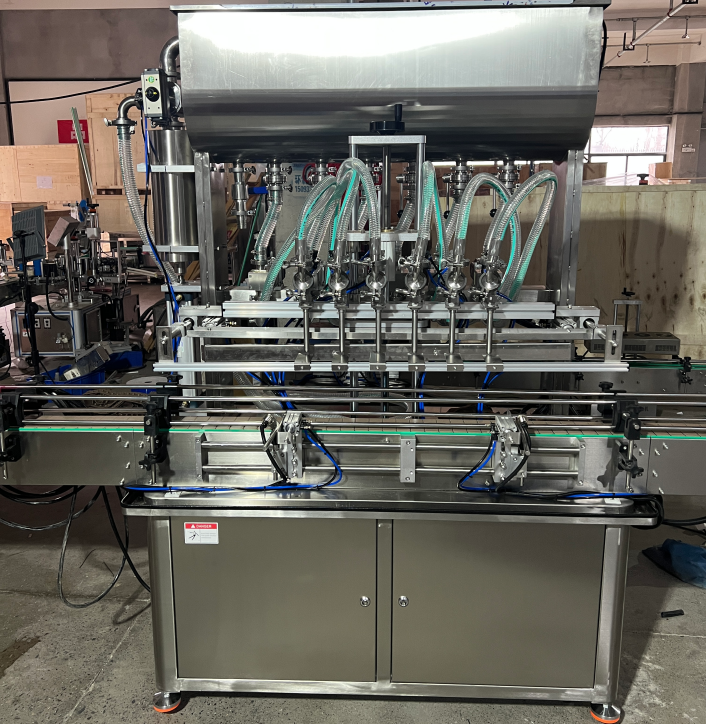
Understanding Fill Accuracy Fundamentals for the 6-Station Gear Pump Filler
Why volumetric consistency across all six stations is critical in pharmaceutical and high-precision manufacturing
Maintaining volumetric consistency at all six production stations is absolutely essential in pharmaceutical manufacturing and other precision industries. Even a small deviation of plus or minus 0.5% at just one station can ruin whole product batches, leading to expensive regulatory issues or recalls that typically cost around $740,000 according to recent studies. When it comes to injectable medications, standards set by USP Chapter 797 require fill volumes to stay within a tight window of plus or minus 1%. The risks multiply in systems with six stations working together. Imagine what happens when one station consistently underfills while another keeps overfilling products. This kind of imbalance destroys the uniform quality needed throughout each batch. Industry leaders in vaccine production report achieving impressive yields of 99.8% only when every station stays below 0.3% relative standard deviation. Keeping these tight controls prevents serious problems like patients receiving insufficient medication doses, packaging failures due to excessive filling, and those dreaded FDA Form 483 inspections that signal major compliance concerns.
Key accuracy drivers: gear geometry, fluid rheology, servo synchronization, and pressure stability
Four interdependent factors govern fill precision:
| Driver | Impact on Accuracy | Optimization Threshold |
|---|---|---|
| Gear geometry | Tooth profile affects displacement | ±5μm tooth wear tolerance |
| Fluid rheology | Viscosity changes alter flow rates | ±1°C temperature control |
| Servo sync | Uneven timing causes volume drift | <2ms station-to-station lag |
| Pressure stability | Fluctuations induce ±0.8% variance | 0.05 bar max deviation |
Gears machined to extremely tight tolerances at the micron level ensure consistent displacement for each rotation they make. For non-Newtonian fluids such as suspensions, special attention must be paid to shear rates to prevent filling errors that can reach around 1.5%. The system uses electronic servos that synchronize perfectly across all six stations, making sure they start and stop within just 2 milliseconds thanks to dynamic braking technology. Pressure sensors accurate to within 0.1% of their full scale help adjust for sudden pressure changes as they happen. Put all these components together properly and the result is remarkable consistency with repeatable results within about 0.25%, something that has been proven through rigorous testing in pharmaceutical applications meeting ISO 9001 standards.
Pre-Delivery Verification Protocol for the 6-Station Gear Pump Filler
Verifying fill accuracy before delivery ensures reliable performance in regulated environments. Gravimetric testing—measuring weight differences—is the gold standard for validating volumetric consistency statistically.
Step-by-step gravimetric validation: test media selection, sample size (n ≥ 30 per station), and repeatability metrics (±% RSD)
Implement this protocol with:
- Test media selection: Use a fluid matching product viscosity and density to simulate real-world conditions accurately.
- Sample size: Collect ≥30 filled units per station to achieve 95% statistical confidence.
- Repeatability metrics: Calculate Relative Standard Deviation (RSD); target <±1% for high-precision applications.
Real-world case: Tier-1 OEM's pre-shipment protocol achieving ±0.25% volumetric repeatability across all six stations
A leading OEM refined this protocol by integrating servo synchronization and pressure stabilization controls. Using n = 180 total samples (30 per station), they achieved ±0.25% volumetric repeatability—surpassing industry benchmarks for uniformity and demonstrating readiness for GMP-compliant production.
Calibration Best Practices Specific to the 6-Station Gear Pump Filler
Three-phase calibration: zero-offset correction, stroke-volume mapping per station, and dynamic electronic braking alignment
Getting calibration right requires a methodical approach tailored to each specific station setup. The first step involves correcting zero offsets so those position sensors don't drift over time. This makes sure every station starts at exactly the same mechanical reference point, which is pretty fundamental for consistent results across the board. Next comes stroke volume mapping where we measure how much fluid each pump displaces per revolution. We use special calibration fluids that match what runs through production lines, and run about twenty cycles at each station just to double check everything works within our tolerance range of less than half a percent variation. Finally there's the dynamic electronic braking alignment part. Basically this syncs up the servo motor deceleration patterns to fight against the natural tendency of fluids to keep moving even when pumps stop suddenly. Without this adjustment, we'd get those pesky overfill issues especially noticeable during fast operations.
When fully implemented:
- Zero-offset errors decrease by 82%
- Inter-station variation falls below ±0.25%
- Viscosity-dependent errors drop by 70%
This multi-phase approach reduces overall fill volume variation by up to 70% compared to single-point adjustments—ensuring consistent volumetric accuracy across all stations, regardless of fluid rheology or cycle speed.
Integrating Real-Time Quality Control into 6-Station Gear Pump Filler Validation
SPC-driven validation: setting station-specific control limits, real-time weight feedback loops, and auto-rejection triggers
Statistical Process Control, or SPC for short, changes how we check quality from something that happens occasionally to something that's constantly monitored. Each station has its own special limits that take into account all sorts of differences like when gears start wearing down, how fluids behave differently, and even changes in temperature around the equipment. The system uses these super accurate load cells to give real time weight information. When it detects something off, it automatically adjusts how much gets filled into each container. This keeps everything within about 0.25% accuracy most of the time. If there's anything that doesn't meet standards, automatic rejection systems kick in right away to get rid of those bad containers before they can cause problems. This cuts way down on the need for people to manually inspect every single item, which saves both time and money in production lines.
Pharmaceutical manufacturers deploying this integrated approach report 30% fewer defects and 45% less production waste—while sustaining synchronized, six-station volumetric precision throughout extended runs.
Frequently Asked Questions
Why is volumetric consistency important in pharmaceutical manufacturing?
Volumetric consistency is crucial to ensure each batch of products meets regulatory standards and avoids expensive recalls. It ensures the uniform quality of medications, preventing issues such as underfilling or overfilling that can lead to serious health and compliance problems.
How does gear geometry affect fill accuracy?
Gear geometry impacts fill accuracy because the tooth profile affects displacement. Ensuring precise gear machining can help maintain accurate volumetric fills.
What are the key steps in gravimetric validation for the gear pump filler?
The key steps include selecting appropriate test media, determining sample size for statistical confidence, and calculating Repeatability metrics such as Relative Standard Deviation (RSD) to evaluate precision.
Table of Contents
- Understanding Fill Accuracy Fundamentals for the 6-Station Gear Pump Filler
- Pre-Delivery Verification Protocol for the 6-Station Gear Pump Filler
- Calibration Best Practices Specific to the 6-Station Gear Pump Filler
- Integrating Real-Time Quality Control into 6-Station Gear Pump Filler Validation
- Frequently Asked Questions