EN
EN

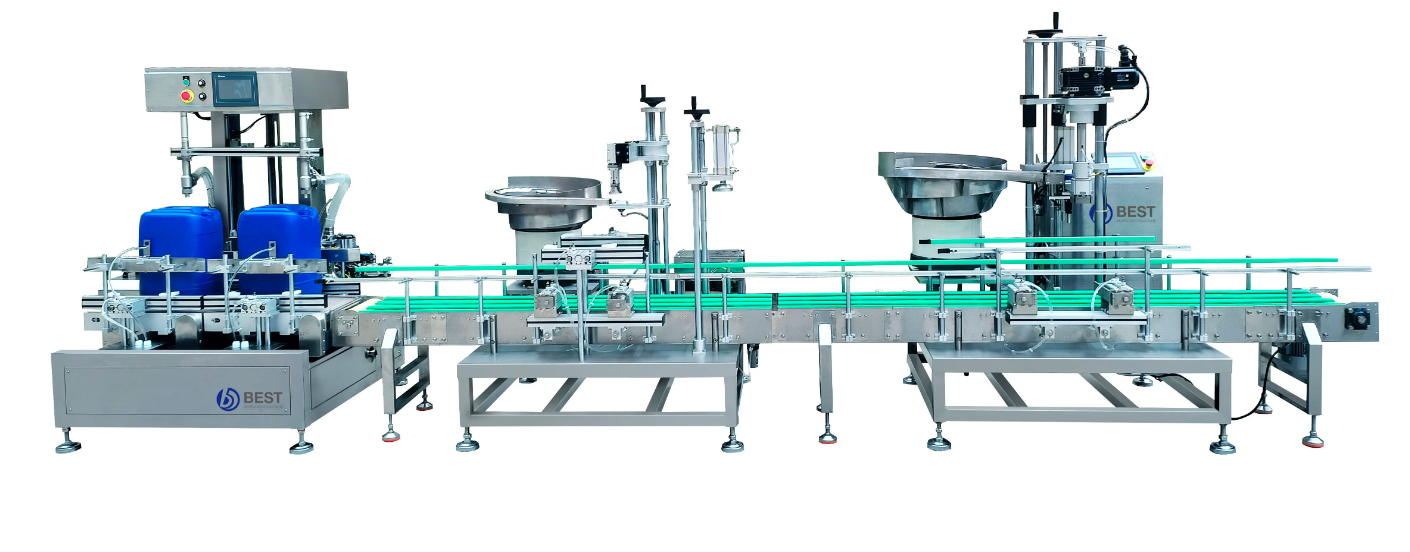
Hidden Product Giveaway Losses in Production
Product giveaway is one of those costs that somehow never makes it onto the monthly P&L as a line item. It gets buried in raw material variance, written off as "process loss," or simply accepted as the cost of doing business. But for any operation filling premium liquids—cosmetics, pharmaceuticals, specialty chemicals—giveaway is not a small number. It is often the single largest source of avoidable expense on the entire line.
A twin-head gravimetric filling and capping line addresses this problem at its root. Instead of managing giveaway through statistical process control and hoping the average stays within tolerance, it eliminates the variability that makes giveaway necessary in the first place. The principle is simple: measure what is actually going into each container, and stop when the target is reached. No more, no less.
Why Gravimetric Filling Beats Volumetric for Giveaway Reduction
Volumetric fillers—whether piston, gear pump, or time-pressure—all share the same fundamental weakness. They measure what goes into the machine, not what comes out of it. A piston displaces a fixed volume of product, but that volume changes with temperature, viscosity, and wear. A gear pump turns a set number of revolutions, but slip changes as clearances open up. A timer opens a valve for a fixed duration, but flow rate drifts with pressure and fluid properties.
Gravimetric filling sidesteps all of these issues because it measures mass directly. Each head has a load cell that weighs the container and its contents throughout the fill cycle. The fill valve operates in two stages—fast for bulk fill, slow for fine adjustment—and closes only when the exact target weight is achieved.
The result is a fill distribution that is dramatically tighter than anything a volumetric system can produce. And tighter distribution means the target weight can be set closer to the declared net weight without risking underfills. That difference—the gap between where a volumetric system must be set and where a gravimetric system can be set—is pure giveaway reduction.
Volumetric fillers typically deliver a fill accuracy of ±1% to ±2%, with 1–3% variable giveaway per container, progressive accuracy drift over production shifts, no real-time correction function, and require high setpoint margins to avoid underfill issues. In contrast, twin-head gravimetric fillers achieve stable accuracy of ±0.3%, with giveaway controlled below 0.3%, zero operational drift, independent real-time correction for every container, and ultra-low setpoint margins, maximizing effective product yield.
The Real-World Math on Giveaway Reduction
Here is where the numbers get concrete. A mid-sized contract packer filling 5-liter pails of industrial hand cleaner at 120 units per hour was running a volumetric piston filler with an effective accuracy of about ±1.2%. To stay compliant with net weight regulations, the setpoint was 50 grams above the declared weight. That was 50 grams of product on every single pail—product that cost money to formulate, mix, and package, and was never paid for.
At 120 units per hour, eight hours a day, five days a week, that added up to 48 kilograms of giveaway per day. Over a 50-week year, roughly 12 metric tons of product—gone. At a material cost of $3.50 per kilogram, that was over $42,000 annually in pure waste. Not a catastrophic number for a large operation, but for a mid-sized facility, that was real margin.
Switching to a twin-head gravimetric filling and capping line with ±0.3% accuracy dropped the required setpoint margin to just 12 grams. Giveaway per pail went from 50 grams to 12 grams—a 76% reduction. Annual material savings exceeded $32,000, and the payback period on the equipment was under 18 months. That is before factoring in the reduced labor for rework, fewer customer complaints, and the ability to run the line faster because the filling station was no longer the bottleneck.
How the Capping Integration Amplifies the Benefit
The "and capping" part of a twin-head gravimetric filling and capping line is not an afterthought. Integrating capping directly after filling creates a closed system that preserves the accuracy gains all the way to the sealed container.
Consider what happens with a standalone filler. Filled containers move to a separate capping station, often on a different conveyor section. During that transfer, containers can tip, spill, or get jostled. Product can slosh out before the cap goes on. Any loss after filling is pure waste, and it is not captured by the filler's accuracy metrics.
An integrated line eliminates that transfer loss. Containers move directly from filling to inner plug insertion and outer capping on the same conveyor. The capping torque is adjustable, and the system handles both plugs and caps in one continuous flow. What was measured at the fill head stays in the container. There is no opportunity for post-fill loss.
For products that are particularly prone to sloshing—low-viscosity liquids, foaming formulations, or anything with a low surface tension—this integration is not just convenient; it is a significant source of additional giveaway reduction that standalone systems simply cannot match.
The Hidden Cost of Overfill That Nobody Talks About
Giveaway is usually discussed in terms of raw material cost, but that is only part of the story. Overfilled containers create downstream problems that add cost in ways that are harder to track.
Overfilled pails are heavier, which increases shipping costs. Over time, that adds up to real money—especially for operations shipping palletized loads where weight brackets determine freight class. Overfilled containers also increase the risk of leakage during transit, because there is less headspace for thermal expansion. Leakers mean returns, replacements, and damaged customer relationships.
A twin-head gravimetric line reduces overfill so consistently that these secondary costs largely disappear. The fill weight is controlled within ±0.3%, which means the headspace is predictable. Containers can be sealed with confidence that they will not leak under normal shipping conditions. And the shipping weight is consistent enough that freight costs become predictable rather than variable.
One pharmaceutical contract manufacturer reported that after installing a twin-head gravimetric filling and capping line, their shipping-related claim rate dropped by nearly 40% within six months. The primary driver was not better packaging—it was simply that containers were no longer overfilled to the point of leakage during temperature swings.
When a Twin-Head System Makes the Most Sense
The economics of a twin-head gravimetric filling and capping line are most compelling for operations filling high-value products in the 5–50 kg range. That is the sweet spot where the cost of giveaway per container is high enough to justify precision equipment, and the throughput requirements are manageable with two filling heads.
For very small containers—under 1 liter—the per-container giveaway cost is lower, and high-speed multi-head systems may be more appropriate. For very large containers—over 50 kg—single-head heavy-duty fillers often make more sense. But for the vast middle ground of industrial pails, chemical drums, and cosmetic bulk containers, the twin-head configuration hits the balance between accuracy, throughput, and capital cost.
The line also handles a wide range of product types—from low-viscosity liquids to creams and sauces—making it a flexible solution for contract packers and multi-SKU operations. Changeover between container sizes takes about five minutes with quick-release fittings and pneumatic clamps, which means the line can switch between products without losing a full shift to downtime.
The Real Metric That Matters
At the end of the day, the question is not whether a twin-head gravimetric filling and capping line reduces giveaway. It does—measurably and substantially. The real question is whether the reduction is large enough to justify the investment. For any operation running premium liquids at any significant volume, the answer is almost always yes.
The numbers are straightforward. The technology is proven. And the savings go straight to the bottom line. Companies like Best Packing have been building this type of integrated equipment for years, with a focus on sanitary construction, reliable PLC controls, and the kind of build quality that keeps a line running shift after shift. For production managers tired of watching product disappear into giveaway, the twin-head gravimetric line offers a clear path to keeping more of what is made.
Table of Contents
- Hidden Product Giveaway Losses in Production
- Why Gravimetric Filling Beats Volumetric for Giveaway Reduction
- The Real-World Math on Giveaway Reduction
- How the Capping Integration Amplifies the Benefit
- The Hidden Cost of Overfill That Nobody Talks About
- When a Twin-Head System Makes the Most Sense
- The Real Metric That Matters