EN
EN

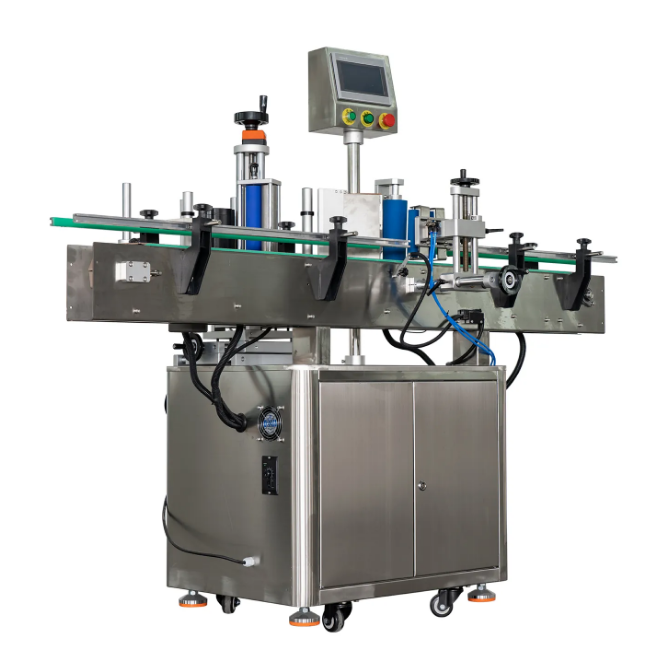
Walk onto any packaging floor running cylindrical bottles and the labeling equipment will likely fall into one of two camps: positioning or non-positioning. The difference isn't subtle, but it's often misunderstood — especially by first-time buyers who assume that any machine that applies a label to a round bottle is essentially doing the same job.
They're not.
A non-positioning cylindrical labeling machine applies the label somewhere on the bottle's circumference. The label wraps around, but its starting point relative to the bottle's seam, handle, or printed artwork is essentially random. The machine doesn't care where the label starts; it just cares that it gets applied.
A positioning machine, by contrast, knows exactly where the label needs to go relative to a specific feature on the bottle. That feature might be a flat panel on an otherwise round container, a seam line, a molded indentation, or even a printed mark that serves as a registration point. The machine finds that feature, orients the bottle accordingly, and applies the label at the precise location required.
The choice between the two isn't about which one is "better." It's about which one fits the product, the label design, and the production workflow.
The Mechanics: How Each System Actually Works
Understanding the difference starts with understanding how each machine handles the bottle. A non-positioning system relies on friction and rotation. The bottle travels down a conveyor and encounters a rotating mechanism — often a sponge belt or a three-roller setup comprising a drive roller, a backing roller, and a pressure roller. The bottle spins, the label feeds, and the label wraps around the circumference. As long as the bottle rotates enough to complete the wrap, the machine is satisfied.
Positioning systems add a detection layer. Sensors look for a specific reference point on the bottle — a notch, a flat spot, a printed registration mark, or even the bottle's physical seam. A vision system with circular illumination can read the position of a defined point and orient the bottle accordingly. Once the bottle is properly aligned, the label is applied at the exact angle or position required.
Some positioning systems use a three-axis positioning mechanism combined with a top-pressing device to hold the bottle stable during the orientation and labeling process. This ensures that even if the bottle has slight variations in shape or size, the label ends up exactly where it's supposed to be.
The mechanical difference translates directly into capability. Non-positioning machines are simpler, faster in many cases, and less expensive. Positioning machines are more complex, slightly slower due to the orientation step, but capable of far greater precision in label placement.
When Non-Positioning Makes Perfect Sense
Non-positioning labeling is the workhorse of cylindrical packaging. For products where the label doesn't need to align with any specific feature on the bottle, it's often the most practical and cost-effective choice.
Think about a typical water bottle. The label wraps around the middle. There's no seam that needs to be covered or avoided. No flat panel that requires the label to start at a particular spot. No printed graphic on the bottle itself that needs to align with the label artwork. The label just needs to be on the bottle, somewhere in the general vicinity of the center. Non-positioning handles this perfectly.
The same applies to many commodity products — cleaning supplies, basic beverages, industrial chemicals, and bulk pharmaceuticals where the label carries standard information and doesn't need to be oriented relative to bottle features. In these applications, the non-positioning machine delivers consistent results at higher speeds and lower cost.
The trade-off comes when label design or regulatory requirements demand precision. If a label needs to cover a specific area, or if two labels need to be applied front and back with exact spacing, non-positioning starts to show its limitations.
When Positioning Is Non-Negotiable
Positioning becomes essential when the label's placement affects product functionality, regulatory compliance, or brand presentation. A few scenarios make this clear.
Cosmetic bottles often have a flat panel on an otherwise round container — the "front" of the bottle where the brand name and product information belong. If the label goes on the back by accident, the product looks wrong. Positioning systems ensure that the label lands on that flat panel every time.
Wine and spirits labeling frequently requires positioning. A wine bottle might need a front label and a back label with specific spacing, or a label that aligns with the bottle's embossed design. Positioning systems can achieve this reliably.
Pharmaceutical applications sometimes require labels at specific angular positions relative to dosage marks or other bottle features. Regulatory labels often have strict placement requirements that non-positioning systems simply cannot meet.
Then there's the dual-label scenario. A disinfectant bottle might need a front label and a back label with precise spacing. A positioning system can apply both labels in the correct orientation relative to each other and to the bottle. A non-positioning system would apply the first label wherever it happened to start and the second label somewhere else — with no guarantee of consistent spacing or alignment.
Speed, Cost, and the Real Trade-Off
The practical difference between positioning and non-positioning often comes down to speed and cost — and the relationship isn't always what buyers expect.
Non-positioning machines are generally faster because there's no orientation step. The bottle enters the labeling zone, spins, gets labeled, and moves on. For high-volume lines running at 100 or more bottles per minute, every millisecond counts, and the orientation step in a positioning system adds measurable cycle time.
Positioning machines are typically more expensive — not because the core labeling mechanism costs more, but because the sensors, vision systems, and orientation hardware add complexity. A positioning system might cost 30% to 50% more than a comparable non-positioning machine, depending on the level of precision required.
But here's the catch: a positioning machine that eliminates rework can pay for that premium faster than a non-positioning machine ever could. If a non-positioning system produces labels that are "good enough" 95% of the time, that 5% rework rate adds up. Labor to strip and reapply, material waste, and the risk of mislabeled product reaching customers — these costs can quickly exceed the upfront price difference.
A recent industry analysis noted that nearly two-thirds of brands are adding automation to packaging operations, with labor cost reduction cited as the primary driver by 61% of respondents. For businesses considering whether to invest in positioning capability, the question isn't whether the machine costs more — it's whether the added precision pays for itself in reduced waste and rework.
The Practical Decision: What to Ask Before Buying
Choosing between positioning and non-positioning starts with a simple question: does the label need to go somewhere specific on the bottle, or does it just need to go on the bottle?
If the answer is the latter — just get it on there — non-positioning is likely the right call. It's simpler, faster, and more affordable. It handles most cylindrical bottles with no fuss and minimal operator intervention.
If the answer is the former — specific location required — positioning is non-negotiable. Don't try to force a non-positioning machine to do precision work. The results will be inconsistent, the rework rate will climb, and the frustration will outweigh any perceived savings.
There's also a middle ground worth considering. Some benchtop systems offer optional circumferential positioning as an add-on feature. This allows a business to start with non-positioning capability and add positioning later if requirements change. For small businesses with evolving product lines, this modular approach can be a smart way to manage capital expenditure while keeping future options open.
The Bottom Line: Match the Machine to the Job
A craft beverage producer in Colorado learned this lesson the hard way. They bought a non-positioning cylindrical labeler for their new line of specialty sodas, assuming that any round-bottle labeler would work. The bottles had a subtle embossed logo on one side that the label was supposed to cover. The non-positioning machine couldn't reliably align the label with the embossing. About 30% of the output had labels that partially missed the embossed area — not catastrophic, but noticeable enough that retail partners started complaining.
They switched to a positioning system with a three-roller orientation mechanism. The new machine cost more upfront, but the rework rate dropped from 30% to under 1% within the first week. At their production volume, the savings in labor and material paid for the price difference in about four months.
That story captures the real difference between positioning and non-positioning. It's not about which technology is superior — it's about which one fits the actual requirements of the product and the production environment. Both have their place. The key is knowing which place is yours.
For operations that need consistent, reliable placement every single time, a positioning system is the only answer that makes sense. For everything else, non-positioning gets the job done efficiently and economically. The right choice depends entirely on the bottle, the label, and the brand's standards.
Manufacturers like BestPropak offer both configurations, with modular options that allow businesses to start with one capability and expand as needs evolve — a practical approach that recognizes that production requirements rarely stay static.