EN
EN

The Hidden Drain: Why Manual Labeling Costs More Than Just Wages
Walk into any small-batch production facility running manual labeling operations, and the numbers tell a story that doesn't show up on the profit-and-loss statement right away. A midsize contract packer in the Midwest tracked their labeling output over six months and found that direct labor accounted for roughly 62% of their total packaging line costs — not because wages were high, but because the throughput per person maxed out at around 12 to 15 bottles per minute on a good day. That ceiling doesn't just cap production; it creates a bottleneck that ripples backward through filling and forward into shipping.
The real cost, however, hides in the variability. One operator might consistently place labels within a reasonable tolerance; another might drift off-center by several millimeters after the second hour of repetitive work. Each misaligned label means rework, and rework means pulling finished product off the line, stripping the old label, cleaning the adhesive residue, and starting over. At a loaded labor rate of roughly $35 to $45 per hour in many regions, those minutes add up fast.
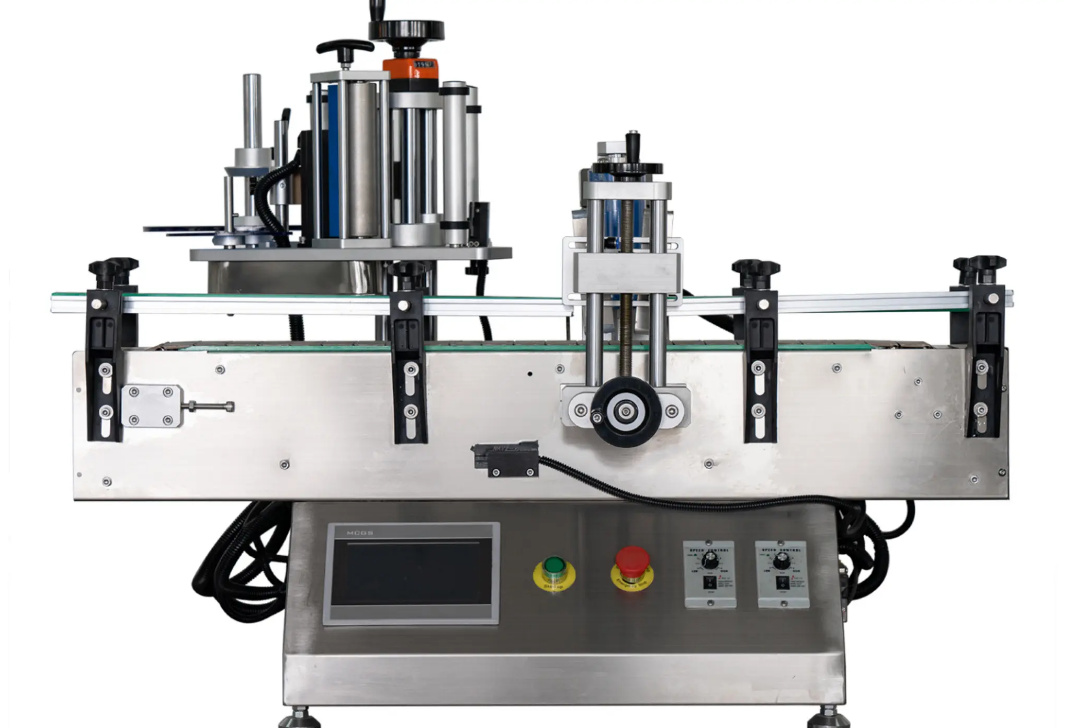
What makes the benchtop cylindrical bottle labeling system different isn't just that it moves faster — it's that it moves the same way every single time. A sensor detects the bottle, the control system fires the label at precisely the right moment, and the labeling mechanism applies it with a consistency that human hands simply cannot sustain over an eight-hour shift.
Breaking Down the Labor Math: From Headcount to Throughput
The simplest way to understand the labor reduction is to look at what happens to headcount. A small business running a single manual labeling station typically needs one dedicated person per shift just to keep labels going onto bottles. For a facility running two shifts, that's two full-time equivalents tied up in a task that requires almost no decision-making but enormous physical repetition.
Switch that same operation over to a benchtop automatic system, and the math shifts. One operator can now manage the labeling machine while simultaneously handling bottle loading, quality checks, and changeovers. The machine does the repetitive motion; the person does the thinking. Some operations report that a single operator can handle what previously required three people. That doesn't mean three people get laid off — it means those people get redeployed to higher-value work like inspection, maintenance, or line optimization.
The throughput difference is equally striking. Manual labeling tops out around 15 pieces per minute for cylindrical bottles, and that's assuming ideal conditions. A benchtop system like the BL-610 runs at 15 to 40 pieces per minute depending on bottle and label size. At the upper end of that range, output more than doubles without adding a single extra person to the payroll.
Beyond the Wage: Error Reduction and Material Waste
Labor cost reduction isn't just about paying fewer people for fewer hours. It's also about paying less for mistakes. Manual labeling introduces a defect rate that's notoriously difficult to quantify because most businesses don't track it rigorously. But the numbers that do exist are telling. Some businesses have reported a 70% to 85% reduction in mislabeling incidents after switching from manual to automated application.
Consider what a mislabel actually costs. There's the label itself — wasted. There's the bottle — possibly ruined if adhesive residue won't come clean. There's the operator time spent removing and reapplying. And there's the reputational cost if a mislabeled product reaches a customer. A benchtop cylindrical bottle labeling system eliminates most of these variables through photoelectric tracking and automatic label correction features. The machine knows when a label is missing. It knows when a bottle isn't present. It won't apply a label to nothing, and it won't double-apply to the same bottle.
Material waste drops for another reason: precision. A manual operator tends to overcompensate for drift by using more label stock than necessary — not intentionally, but because the margin for error shrinks as fatigue sets in. Automated systems apply labels with ±1mm accuracy, which means less trimming, less repositioning, and less scrapped material overall.
The Space Equation: Compact Footprint, Big Impact
Small businesses don't have the luxury of sprawling factory floors. Every square foot has to earn its keep. A benchtop cylindrical bottle labeling system occupies roughly the same footprint as a standard workbench — the BL-610 measures about 1260×1080×931mm. That's a far cry from the massive inline systems that require dedicated conveyor sections and permanent installation.
What this means in practice is that the machine can be rolled into an existing space without reconfiguring the entire production floor. For a small business that's already tight on square footage, that's not a minor convenience — it's the difference between being able to automate and being forced to stay manual. Facilities with limited space can integrate these units into existing lines or use them as standalone stations that don't disrupt surrounding workflows.
The compact design also means the system can move with the business. If production ramps up and a larger facility becomes necessary, the benchtop unit doesn't become stranded infrastructure. It can be relocated, repurposed, or kept as a backup line without the logistical nightmare of dismantling permanent installations.
A Real-World Scenario: The Craft Beverage Bottler
A craft beverage operation in the Pacific Northwest was running three manual labeling stations across two shifts. Each station required one operator, and the best they could sustain was about 18 bottles per minute per person. The bottleneck was costing them roughly 40% of their potential output during peak seasonal demand.
They brought in a benchtop cylindrical bottle labeling system and reconfigured their workflow. Instead of three manual stations, they set up one automated station with one operator managing the feed and another doing quality checks on the output. The machine ran at 32 bottles per minute consistently — almost double the output of a single manual station — and freed up two operators per shift to handle other tasks like label roll changes, machine maintenance, and final packaging.
The labor savings weren't just theoretical. Their total labeling headcount dropped from six people across two shifts to two people across two shifts — a 67% reduction in direct labor for that part of the line. And because the machine applied labels with ±1mm accuracy, their rework rate fell from roughly 4% of output to under 0.5%. At their production volume, that translated to over 2,000 fewer bottles needing rework per month.
When a Benchtop System Makes Sense — and When It Doesn't
No piece of equipment is the right answer for every situation, and a honest assessment means acknowledging the limitations. A benchtop cylindrical bottle labeling system works best for operations running at moderate speeds — typically under 50 pieces per minute. For high-volume lines pushing 100 or more bottles per minute, an industrial inline system with higher throughput capacity is probably the better fit.
The other consideration is changeover frequency. Benchtop systems handle changeovers well, typically within minutes and without tools, but if a production run involves switching bottle sizes or label formats every hour, the cumulative downtime might offset some of the labor savings. The sweet spot is for businesses running batch sizes that justify the changeover time — think hundreds or thousands of units, not dozens.
That said, for the vast majority of small to medium operations — craft food producers, cosmetic manufacturers, specialty chemical blenders, and contract packers — the benchtop format hits a balance that larger systems can't match. It delivers enough speed to matter, enough precision to eliminate rework, and enough flexibility to handle the variety that small businesses typically deal with.
The global labeling equipment market reflects this growing adoption, with projections showing expansion from roughly $4.5 billion in 2024 to $7.8 billion by 2033. Much of that growth is driven by small and medium enterprises finally making the jump from manual to automated labeling — not because the technology is new, but because the cost-benefit equation has shifted decisively in favor of automation.
For businesses ready to make that move, the benchtop cylindrical bottle labeling system offers a practical path forward — one that reduces labor costs not by eliminating people, but by making every person on the line dramatically more productive.
Table of Contents
- The Hidden Drain: Why Manual Labeling Costs More Than Just Wages
- Breaking Down the Labor Math: From Headcount to Throughput
- Beyond the Wage: Error Reduction and Material Waste
- The Space Equation: Compact Footprint, Big Impact
- A Real-World Scenario: The Craft Beverage Bottler
- When a Benchtop System Makes Sense — and When It Doesn't