EN
EN

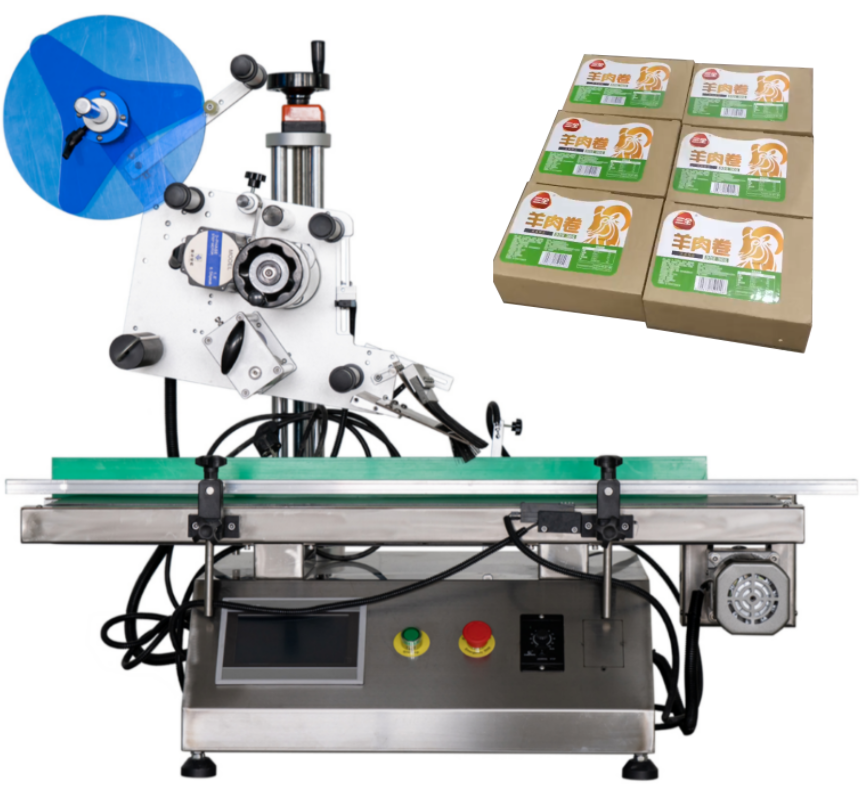
The Flat Product Labeling Problem
Flat products present a deceptive labeling challenge. They look simple—flat surfaces, straightforward geometry. But the variety is staggering: cartons, trays, bags, pouches, blister packs, box tops, lids, and countless other formats. Each has different dimensions, different materials, and different production line characteristics. A labeling solution that works for cardboard cartons may fail entirely for flexible pouches. One that handles trays beautifully might struggle with uneven surfaces.
Top labeling—using an automatic top label applicator—addresses this diversity better than any other labeling method. The reason is fundamental: top labeling applies the label from above, perpendicular to the product surface. This simple geometry makes it adaptable to an extraordinary range of product shapes, sizes, and materials without major reconfiguration.
Why Top Labeling Works Across So Many Formats
The versatility of top labeling comes down to three factors: access, orientation, and tolerance.
Access: The top surface of a flat product is almost always exposed on a production line. Unlike side labeling, which requires clear access to the sides of the product, top labeling only needs clearance above the product. This is almost always available, even on tightly packed conveyors.
Orientation: Top labeling does not require precise rotational orientation of the product. The label goes on the top surface, period. As long as the product passes under the applicator with the top facing up—which is how flat products naturally travel on a conveyor—the label will land correctly. This eliminates the complex positioning systems required for wrap-around or side labeling.
Tolerance: Top label applicators can accommodate significant variation in product height and position. A typical tamp-blow applicator, for example, uses a vacuum pad to pick up a label and then tamp it onto the product surface. The tamping stroke absorbs height variations, so products that are slightly taller or shorter than nominal still receive properly placed labels. This tolerance is invaluable in real production environments where containers often vary within acceptable dimensional limits.
The Technical Approaches: Tamp-Blow, Air-Blow, and Merge-Type
Automatic top label applicators come in three main configurations, each suited to different production requirements.
Tamp-blow applicators are the most common. A vacuum pad picks a label from the peel plate, the pad moves down to the product surface, and the vacuum releases, applying the label. The tamping action provides positive pressure, ensuring good adhesion even on slightly uneven surfaces. These systems are ideal for products that are rigid or semi-rigid and where the label needs a firm press.
Air-blow applicators use a jet of air to blow the label onto the product surface. The label is peeled from the liner and suspended briefly before being blown onto the product. This method works well for lightweight labels and products that cannot tolerate physical contact from a tamp pad—fragile items or products with delicate surfaces.
Merge-type applicators apply the label as the product passes underneath, using a roller or wiper to smooth the label onto the surface. These are the fastest of the three types and work well for high-speed lines with consistent product spacing.
The ability to choose among these approaches—or to use a single applicator that can be reconfigured between modes—adds another layer of versatility to top labeling systems.
Real-World Applications Across Industries
The proof of versatility is in the applications:
Food packaging: Cartons of frozen entrees, trays of fresh meat, boxes of crackers, bags of coffee. Top labels carry branding, nutritional information, and barcodes. The same automatic top label applicator can handle all of these with simple parameter changes.
Pharmaceuticals: Blister packs, pill bottles with flat caps, cartons of medical devices. Regulatory labels require precise placement and readability. Top labeling delivers the consistency needed for compliance.
Cosmetics and personal care: Boxed products, flat bottles with top surfaces, compact cases. Aesthetic label placement is critical, and top labeling provides the clean, centered application that premium brands demand.
Household chemicals: Detergent boxes, cleaning product bottles with flat tops, spray can lids. These products often run on high-speed lines where reliability matters as much as accuracy.
A contract packager in the Southeast that handles over 200 different SKUs across food, pharmaceutical, and consumer goods categories standardized on top labeling for all flat products. Their reasoning: one machine type, one set of spare parts, one training protocol for operators. The flexibility to switch between a cereal box in the morning and a pharmaceutical carton in the afternoon without changing the applicator head—just updating the recipe—saved them over $40,000 annually in changeover labor and downtime.
The Economics of Versatility
Versatility has a direct impact on the bottom line. A labeling system that handles multiple product formats reduces the need for dedicated machines for each format. That means less capital expenditure, less floor space, and lower maintenance costs.
The operational economics are equally compelling. A PMMI survey from 2023 found that 58% of packaging operations prioritize flexibility over raw speed. The reason is straightforward: in a market where product lifecycles are shortening and SKU proliferation is accelerating, the ability to switch between products quickly is more valuable than the ability to run a single product slightly faster.
Top labeling systems achieve changeovers measured in minutes, not hours. Tool-free adjustments, recipe storage, and modular applicator heads all contribute to rapid changeover capability. A typical changeover on a top label applicator involves selecting the new recipe on the HMI, adjusting the conveyor guides if necessary, and running a verification check. Total time: under five minutes for most operations.
Where Top Labeling Has Limits
Versatility does not mean universality. Top labeling has clear limitations that any honest assessment should acknowledge.
First, top labeling only applies to the top surface. Products that require labels on sides, bottoms, or multiple surfaces need additional applicators or a different approach. For a product that needs front, back, and top labels, a combination system is required.
Second, the product must present a reasonably flat top surface. Highly curved, domed, or irregular surfaces may not accept a top label effectively—the label will wrinkle or fail to adhere at the edges. While some applicators can handle slight curvature, significant contours require specialized equipment.
Third, the label itself must be compatible with top application. Thin, flimsy labels may be difficult to handle in air-blow systems, while very thick or rigid labels may not conform to even slight surface variations.
For products that fit within these constraints—and most flat products do—top labeling offers an unmatched combination of versatility, speed, and reliability. The automatic top label applicator has become a standard component in packaging lines precisely because it delivers consistent results across a wide range of applications.
Making the Choice: What to Look For
When selecting a top label applicator for versatile operation, several features matter:
Adjustable applicator head: The head should move vertically and horizontally to accommodate different product sizes and positions.
Recipe storage: At least 50 recipes should be storable, with easy recall via the HMI.
Tool-free adjustments: Guide rails, label guides, and pressure settings should adjust without tools to minimize changeover time.
Sensor flexibility: The product detection sensor should be adjustable for different product heights and colors.
Modular design: The ability to swap applicator heads between tamp-blow, air-blow, or merge-type configurations adds long-term flexibility.
A facility in the Pacific Northwest processing frozen foods switched to a modular top labeling system after struggling with dedicated labelers for each product family. Within six months, they reduced their labeling equipment inventory from seven machines to three, cut spare parts costs by 40%, and improved overall line utilization by 12%. The versatility of top labeling—backed by smart equipment choices—made the difference.
Top labeling is not the answer for every labeling challenge. But for flat products, it is the most versatile solution available. Manufacturers like BestPropak offer automatic top label applicators designed with the flexibility that modern production lines demand—helping operations stay agile without sacrificing quality or consistency.