EN
EN

Why Wine Bottles Are Different
Wine bottles are not just round containers. They have distinct shapes—Bordeaux, Burgundy, Hock, Champagne—each with different tapers, shoulder angles, and base configurations. They come in multiple colors: flint, amber, antique green. And they almost always require precise label placement relative to the bottle seam or embossed features. A label that is off by even a few millimeters on a wine bottle looks sloppy. In an industry where packaging aesthetics directly influence perceived quality and price point, that is not acceptable.
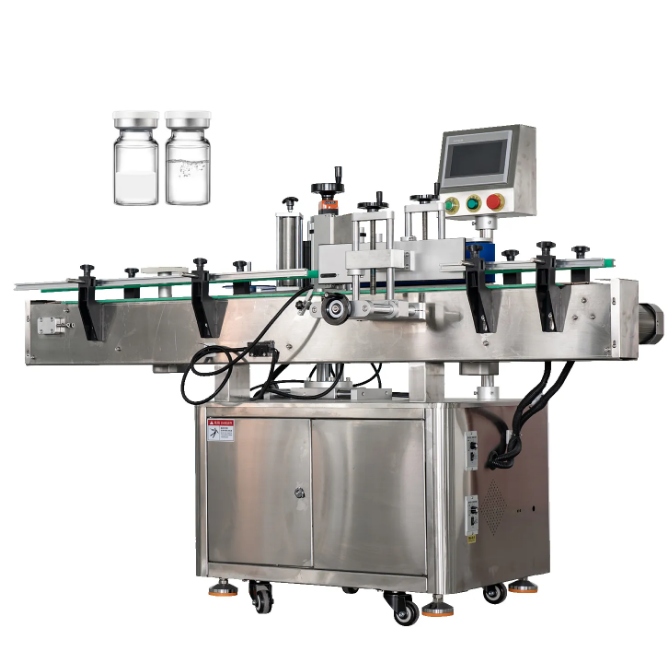
An automatic cylindrical bottle positioning labeling machine addresses these challenges through a combination of mechanical handling, sensor-based positioning, and programmable control. The setup process determines whether the machine delivers consistent, gallery-quality results or produces a stream of misaligned labels that waste material and frustrate operators.
Physical Setup: Conveyor, Guides, and Bottle Handling
The physical installation starts with the conveyor and guide rails. Wine bottles vary in diameter from about 60mm for a standard Bordeaux bottle to over 90mm for some Champagne or large-format bottles. The guide rails must accommodate the widest bottle the line will run and adjust down for narrower formats. Most machines use quick-release clamps or handwheels for rail adjustments, allowing changes without tools.
Bottle spacing is equally important. The infeed screw or starwheel separates bottles at consistent intervals, ensuring each bottle enters the labeling station with the same gap. For wine bottles, which often have irregular surfaces due to embossing or textured glass, the spacing mechanism needs enough grip to maintain control without marring the glass.
The bottle handling system also includes a rotating mechanism—typically a set of rollers or a belt drive—that spins the bottle during label application. For cylindrical wine bottles, this rotation must be smooth and synchronized with the label feed. Any stutter or slip creates wrinkles or misalignment. During setup, operators should run a few test bottles through with the label feed disabled and observe the rotation. It should be steady and even, with no visible wobble.
Positioning: Finding the Seam or Reference Point
This is where wine bottle labeling differs from general-purpose cylindrical labeling. Most wine bottles have a seam line from the molding process. Premium wines often require the label to be centered relative to that seam, or relative to a specific embossed feature like a crest or emblem.
The positioning system uses a sensor—typically a laser or photoelectric eye—to detect the seam or a reference mark. The bottle rotates until the sensor finds the target, then stops in the correct orientation for labeling. Some advanced systems use vision cameras for this purpose, offering greater flexibility for bottles with subtle or hard-to-detect features.
Setting up the positioning sensor requires careful calibration. The sensor must be aimed at the correct height on the bottle—seam lines are usually vertical, so the sensor detects them at a specific elevation. The sensitivity threshold must be set so the sensor reliably detects the seam without being triggered by other surface features like embossing, labels from previous runs, or glass imperfections. A common field technique: run a batch of bottles and observe the sensor trigger rate. If it misses more than 1 in 50 bottles, the threshold or positioning needs adjustment.
Label Application Parameters: Feed, Speed, and Pressure
With the bottle positioned, the label application parameters come next. The label feed length must match the bottle circumference. For a full-wrap label, the feed length equals the circumference plus a small overlap. For a front-and-back label configuration—common on wine bottles where a front label and a back label are applied separately—the feed length and timing must be coordinated.
The application speed is governed by the bottle rotation speed and the label feed rate. These must be synchronized. If the label feeds faster than the bottle rotates, it piles up and wrinkles. If it feeds slower, the label stretches or tears. Most modern machines use servo motors for both functions, with the controller coordinating the two movements. Setup involves entering the bottle diameter and label length into the HMI, and the system calculates the synchronization automatically.
Pressure is the final variable. Wine labels are typically paper or foil-based with adhesive backing. The pressure roller must press the label onto the bottle with enough force to ensure full adhesion but not so much that it deforms the label or leaves roller marks. A good check: after labeling, peel a corner of the label back. It should resist peeling and show uniform adhesive transfer across the entire surface.
Recipe Management and Changeover Efficiency
Wine producers rarely run a single SKU. A typical winery might produce a dozen different wines, each with its own bottle shape, label size, and placement requirements. The ability to switch between these configurations quickly is what separates a functional setup from an efficient one.
Modern labeling machines store setup parameters as named recipes. Each recipe includes bottle diameter, height, label length, sensor position, pressure setting, and feed timing. When changing from a Bordeaux to a Burgundy bottle, the operator selects the new recipe and the machine adjusts automatically. The physical guide rails still need manual adjustment—no automation can replace that—but the electronic parameters are ready in seconds.
A Napa Valley winery tracked their changeover times before and after implementing a recipe-based system. The average changeover dropped from 35 minutes to 8 minutes. That meant they could run smaller batches economically, reducing inventory and improving cash flow. The winery's production manager noted that the biggest time savings came not from the adjustments themselves but from eliminating the trial-and-error phase—operators no longer had to guess at settings and run test bottles to verify.
Common Setup Pitfalls and How to Avoid Them
Even with a well-designed machine, setup errors happen. Here are the most common and how to catch them early:
Incorrect sensor height: The seam sensor must be positioned at the right elevation. If it is too high or too low, it may miss the seam entirely or detect the wrong feature. Check the sensor alignment against a marked reference bottle.
Insufficient bottle grip: If the rollers or belts do not grip the bottle firmly, the rotation slips during labeling. This shows up as incomplete wrap-around or a label that is skewed. Increase the grip pressure gradually until the rotation is stable.
Label feed tension: Too much tension stretches the label; too little causes slack and misregistration. The label should feed smoothly off the roll with a slight drag but no visible stretching.
Incorrect label start position: The label must start at the correct point relative to the seam. If the start position is off, the label seam will not align with the bottle seam. Adjust the start offset in the HMI in small increments until the alignment is correct.
A practical validation routine: after setup, label 20 bottles and inspect every one. Check seam alignment, vertical position, wrinkle presence, and edge adhesion. If any defects appear, diagnose and correct before running full production. This 20-bottle check takes less than two minutes and prevents hundreds of defective labels from reaching the market.
Integration with Downstream and Upstream Equipment
The labeling machine does not operate in isolation. It sits between the filling/corking station and the packaging/palletizing area. The setup must account for the speed and timing of adjacent equipment. If the filler runs at 40 bottles per minute but the labeler is set for 45, bottles will back up. If the labeler runs slower, the filler will starve.
Most systems use a master PLC that synchronizes the entire line. The labeling machine receives a speed reference from the master controller and adjusts its operation accordingly. During setup, operators should verify that the labeling machine's speed range matches the line speed and that the handshake signals between machines are working correctly.
Wine bottling lines also frequently include coding equipment—inkjet printers or laser coders—that apply batch codes or dates to the bottle or label. The labeling machine setup should consider the position of the coding station relative to the labeler to ensure the code lands in the correct location.
The automatic cylindrical bottle positioning labeling machine for wine bottles is not a complicated piece of equipment, but it demands attention to detail during setup. The difference between a good setup and a great one shows up in the consistency of the output—bottle after bottle, shift after shift. Manufacturers like BestPropak design their systems with wine producers in mind, offering the precision positioning and quick-change capabilities that wineries need to maintain quality across diverse product lines.
Table of Contents
- Why Wine Bottles Are Different
- Physical Setup: Conveyor, Guides, and Bottle Handling
- Positioning: Finding the Seam or Reference Point
- Label Application Parameters: Feed, Speed, and Pressure
- Recipe Management and Changeover Efficiency
- Common Setup Pitfalls and How to Avoid Them
- Integration with Downstream and Upstream Equipment